Increased operational efficiency of design team by 30% with design ops
XWP is an agency that builds enterprise WordPress platforms for publishers and brands. Most people there are engineers, and I spent my time there growing the design team and the way it works.
- My role
- Principal Product Designer / Design Lead
- Industry
- Enterprise WordPress
- Business
- Agency
- Date
- 2021–2024
My role
I was a Principal Product Designer and, for about half of my time, I also took on the Design Lead responsibilities. I reported to the CDO. At its biggest, the team I led had five designers: three seniors, one mid-level and one junior. Each of them worked on a different client project and reported to me.
My job was to build a design team inside a company run mostly by engineers, and to raise the quality of design at XWP overall. In practice that meant a lot of time with the CTO, the delivery team, and the marketing and branding people, showing them where design helps.
Key achievements
- Set up hiring for designers from scratch, using XWP’s engineering hiring process as the starting point.
- Wrote our design process documentation (based on the Double Diamond) and gave every new designer an onboarding buddy.
- Ran bi-weekly 1:1s, a weekly design sync and design crits.
- Took care of quarterly goals, career growth and performance reviews for the team.
- Built Astro Kit, a Figma design system for WordPress projects, which later became Launchpad, the boilerplate our engineers start every project with.
- Added design discovery, a project framework and visual QA by designers to new client projects.
- Higher design team velocity on client projects
- 30%
- Faster project kick-off with Launchpad (estimate)
- 40%
- Design team eNPS (estimate)
- +60
Project Background
XWP builds and maintains WordPress platforms for large publishers and brands. The company grew out of engineering, so design was usually seen as something that happens before development starts. Our designers were spread across client projects and mostly worked on their own.
There was no shared design process, no common toolkit and no clear way to hire designers or help them grow. Explaining what design adds to a project was part of the job.
Objectives
- Show engineering, delivery and leadership what design brings to a project.
- Give designers one process and one toolkit, whichever client they work for.
- Create a way to hire, onboard and grow designers.
- Offer design to clients as a service of its own.
The Challenge
I didn’t have a mandate to change how delivery worked. Every change had to make sense to the people running projects, or it wouldn’t stick.
So I worked closely with the CTO, engineering leads, project managers, HR, and the marketing and branding teams, and tried to prove the value of early design work one project at a time.
Keeping the team together
With every designer on a different client, it was easy for the team to drift apart. We kept a simple routine:
- bi-weekly 1:1s with each designer,
- a weekly design sync to share progress and problems across projects,
- design crits, so work was reviewed by the team before it went to a client.
I also owned quarterly goals, career growth and performance reviews, so we talked about growth regularly and around real project work.
Hiring and onboarding
XWP had a solid hiring process for engineers and nothing for designers. Instead of inventing something new, I adapted the engineering process for designers, with a portfolio review, a design task, interview stages and scorecards.
For onboarding, I wrote down our design process, based on the Double Diamond, and agreed it with the designers on projects. Every new person also got a buddy to help them settle in.
Astro Kit and Launchpad
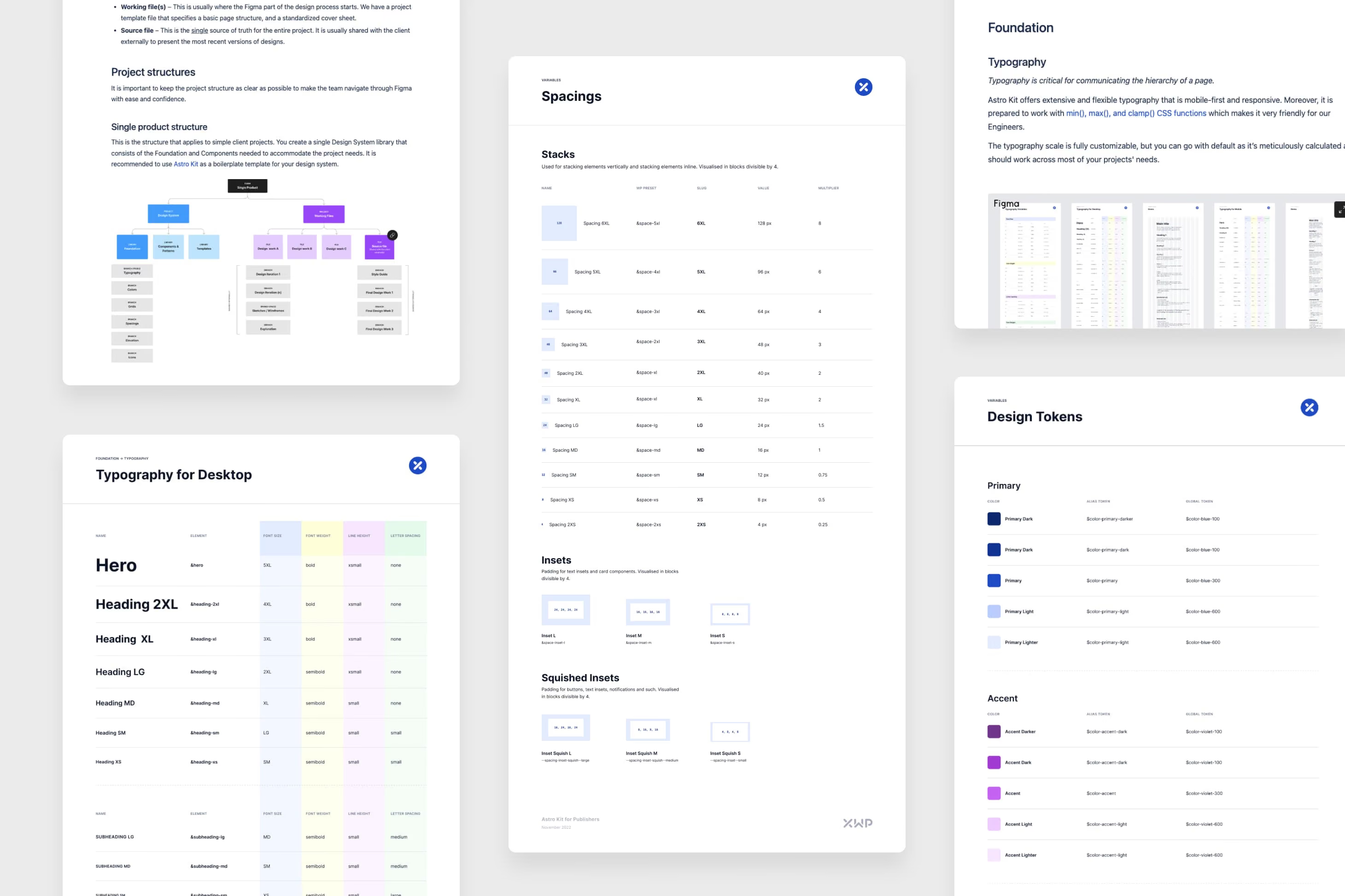
I built Astro Kit and led its growth. It started as a Figma design system made to fit WordPress: the type scale works with min(), max() and clamp(), and the spacing and color tokens follow WordPress presets, so engineers could use them as they were.
It also set a project structure for Figma. Every client got a design system library (foundations, components, templates), working files, and one source file we shared with the client.
Later, Astro Kit was turned into Launchpad. The development teams adopted it and now use it as the boilerplate for each new project. Since design and code start from the same foundations, projects get going much faster and handoff is easier.
A framework for every client
On top of the toolkit, we added a few steps to every new client project:
- design discovery at the start, to agree on goals and scope,
- a design system and project framework built on Astro Kit,
- a simpler handoff, thanks to shared tokens and structure,
- visual QA by designers before release.
Key Takeaways
In a company full of engineers, the best way I found to grow design was to make delivery easier for them. When Astro Kit became Launchpad, a design tool turned into the place where every engineering project starts, and that did more for design at XWP than any presentation I gave.
What I’m most proud of is the team: a group of designers with a shared process, a way to grow, and a toolkit that every project starts from.